
The word flank is one of those versatile terms that shows up in many different areas military strategy, anatomy, sports, cooking, and everyday conversation.
Because it’s used across so many fields, its meaning can feel confusing if you don’t know the context.
Understanding the flank meaning is useful because the word almost always refers to a side position or side area, but what that side represents depends entirely on how it’s being used.
This article explains what flank means, where it comes from, how people use it today, and why context is essential.
What Does Flank Mean?
At its most basic level, flank refers to the side of something, especially the left or right side of a body, object, group, or formation.
In simple terms, flank can mean:
- A side position
- The area beside a main section
- A vulnerable or strategic side
For example:
- “Pain in the flank”
- “The team attacked from the flank”
The core idea is side placement, not the front or center.
The Origin of the Word Flank
The word flank comes from older language meaning side or hip. Over time, it became widely used in military and anatomical language before expanding into everyday speech.
Its long history explains why it appears in such different contexts today.
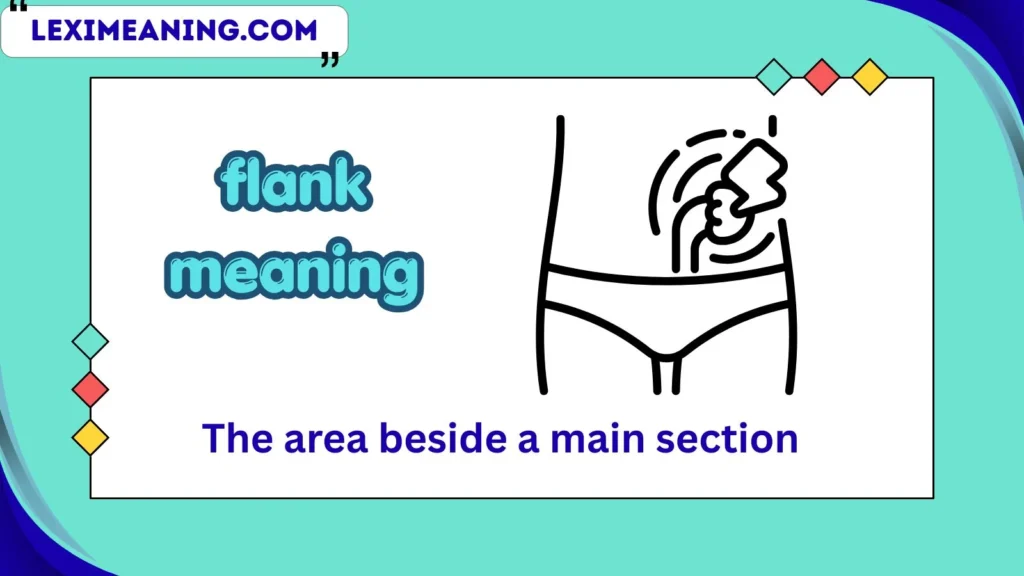
Flank Meaning in Anatomy and Medicine

In anatomy, flank refers to:
- The side of the body
- The area between the ribs and the hip
People often use it when describing physical sensations or medical symptoms.
Examples:
- “He felt sharp pain in his flank.”
- “The doctor examined the flank area.”
In this context, flank helps specify location clearly.
Flank Meaning in Military and Strategy
One of the most well-known uses of flank is in military strategy.
Here, flank refers to:
- The side of an army or formation
- A position that can be attacked or defended
Phrases like flanking maneuver describe attacking from the side rather than head-on, often to gain advantage.
This usage emphasizes strategy, positioning, and awareness.
Flank Meaning in Sports
In sports, flank commonly refers to:
- The sides of the playing field
- Positions near the edges
Examples include:
- Soccer players operating on the flank
- Attacks launched from the flank
In this sense, flank highlights space, movement, and tactical advantage.
Flank Meaning in Cooking and Food
Flank is also used in cooking, particularly when referring to meat.
For example:
- Flank steak comes from the side of the animal
This cut is known for:
- Being lean
- Having strong muscle fibers
- Requiring specific cooking techniques
Here, flank once again refers to the side portion.
Flank Meaning in Everyday Language
In casual conversation, flank can be used metaphorically.
Examples:
- “He was flanked by security guards.”
- “The building is flanked by trees.”
In these cases, flank means:
- Positioned on either side
- Surrounded or bordered
It adds descriptive clarity to spatial relationships.
Examples of Flank in Real-Life Sentences
Medical Context
“She complained of pain along her flank.”
Sports Context
“The winger pushed down the flank.”
Descriptive Context
“The road was flanked by tall buildings.”
Each example shows how the same word adapts to different situations.
Flank vs Similar Words
Flank is sometimes confused with other location-based words.
Top Flank vs Side
- Side is general
- Flank often sounds more precise or technical
And Flank vs Edge
- Edge refers to a boundary
- Flank refers to the side area itself
Flank vs Rear
- Rear refers to the back
- Flank refers to the left or right side
These distinctions matter in technical contexts.
Why Flank Often Implies Strategy or Vulnerability
In many uses especially military and sports flank implies:
- Opportunity
- Exposure
- Tactical importance
Sides are often less protected than the front, which is why the word carries strategic weight.
Common Misunderstandings About Flank
Flank Always Refers to the Body
Not true. It applies to many non-physical contexts.
Flank Means the Back
Flank refers to the side, not the rear.
Real Flank Is Only a Technical Term
While technical in some uses, it’s also common in everyday language.
Why Context Is Essential for Understanding Flank
To understand flank correctly, ask:
- What is being described?
- Is it physical, strategic, or metaphorical?
- Is it referring to location, movement, or position?
Context tells you whether flank refers to anatomy, strategy, space, or description.
Flank Meaning in Modern Usage
flank remains widely used because:
- It’s precise
- It’s adaptable
- It works across disciplines
From healthcare to sports commentary, the word continues to be relevant.
How to Use Flank Correctly
To use flank naturally:
- Use it when describing sides or side positions
- Pair it with clear context
- Avoid using it when “back” or “front” is more accurate
Good examples:
- “The entrance is flanked by pillars.”
- “The player moved quickly along the flank.”
Why Understanding Flank Meaning Is Useful
Knowing the flank meaning helps you:
- Understand medical descriptions
- Follow sports and military discussions
- Interpret descriptive writing accurately
- Use precise language
It’s a small word with wide application.
Flank as a Descriptive Tool
Flank adds detail by specifying position rather than leaving location vague. That’s why it’s often used when clarity matters.
Conclusion:
The flank meaning centers on the idea of a side position whether it’s the side of the body, a strategic formation, a sports field, or a physical structure. While the contexts vary, the core idea remains the same.
Flank continues to be a valuable word because it communicates position, strategy, and structure with precision. Understanding it helps you interpret and describe the world more clearly.
💬 Which context do you hear “flank” used in most sports, medicine, or everyday language?
Share your thoughts in the comments!

I’m Daniel Brookes, the creator of LexiMeaning.com, where I make words, phrases, and their meanings simple and easy to understand. I’m passionate about clear language and helping readers discover the meaning, usage, and context behind everyday words. Through LexiMeaning.com, I aim to make learning new words simple, useful, and enjoyable.