
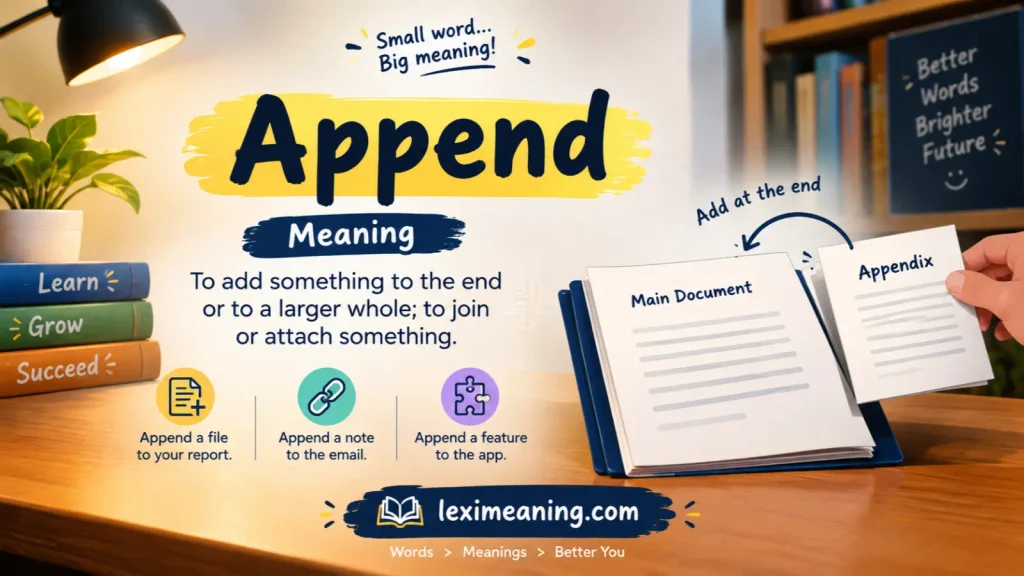
The word append shows up often in writing, technology, education, and everyday communication. You might hear it in phrases like “append the document,” “append data,” or “appendix included,” and wonder what it actually means in each case.
Understanding the append meaning is useful because it helps you follow instructions accurately, especially in professional, academic, or technical settings.
While the word may sound formal, its core idea is simple. This article explains what append means, how it’s used across different contexts, and why clarity matters updated for 2026.
What Does Append Mean?
At its core, append means to add something to the end of an existing item. The key idea is placement—what’s added comes after the main content, not in the middle or at the beginning.
In simple terms, append can mean:
- To attach additional material
- To add information at the end
- To include something as a supplement
For example:
- “Please append your signature at the end.”
- “The notes were appended to the report.”
The original content remains intact; something new is added after it.
The Origin and Basic Concept of Append
The word append comes from older language meaning to hang onto or attach. Over time, its meaning narrowed to describe adding something in a specific position—at the end.
This idea of extension rather than insertion explains how the word is used today across many fields.
Append Meaning in Writing and Documents
In writing, append is commonly used when adding extra information to a document.
Examples include:
- Appending references
- Appending footnotes
- Appending additional explanations
For instance:
- “The author appended a glossary.”
- “Extra details were appended for clarity.”
The appended material supports the main content without interrupting it.
Append Meaning in Technology and Data
In technical and digital contexts, append is frequently used.
It often refers to:
- Adding data to the end of a file
- Attaching text to existing content
- Extending lists or records
Examples:
- “The system appends new entries automatically.”
- “The program appends the results to the file.”
Here, append emphasizes sequence and order.
Append in Emails and Communication
In professional communication, append may refer to:
- Adding attachments
- Including additional notes at the end
- Supplementing previous messages
For example:
- “I’ve appended the updated file.”
- “Please see the appended comments.”
This usage highlights completeness and follow-up.
Append Meaning in Academic and Research Contexts
In academic work, append often relates to:
- Supplementary data
- Supporting charts or tables
- Extended explanations
For example:
- “Survey results were appended.”
- “The appendix was appended to the thesis.”
This allows researchers to provide depth without overloading the main text.
Append vs Similar Words
The append is often confused with other terms, but there are clear differences.
Append vs Add
- Add is general
- Append specifically means add at the end
😮Append vs Insert
- Insert places something within
- Append places something after
Append vs Attach
- Attach can be separate
- Append becomes part of the whole
Understanding these distinctions improves clarity.
Examples of Append in Everyday Sentences
Workplace Example
“Please append the budget summary.”
Technical Example
“The software appends data automatically.”
Academic Example
“The charts were appended at the end.”
Each example reinforces the idea of addition at the end.
Why Append Sounds Formal
Append often appears in:
- Instructions
- Documentation
- Official communication
Because of this, it can sound more formal than saying “add,” but the meaning is more precise.
Common Misunderstandings About Append
Append Means Insert Anywhere
Append always refers to adding at the end.
🤔Append and Appendix Are the Same
Append is a verb; appendix is a noun referring to added material.
Append Means Replace
Appending adds content—it doesn’t remove or overwrite existing material.
Why Context Is Important When Using Append
To understand append correctly, consider:
- What is being added
- Where it’s being added
- Whether order matters
Context clarifies whether the usage is technical, academic, or conversational.
Append Meaning in Modern Usage (2026)
In 2026, append remains widely used because:
- Digital systems rely on ordered data
- Documentation requires precision
- Clear instructions matter more than ever
The word continues to serve as a precise alternative to more general terms.
How to Use Append Correctly
To use append naturally:
- Use it when order matters
- Specify what is being appended
- Avoid using it when “insert” is more accurate
Good examples:
- “Append the form at the end.”
- “The system appends updates automatically.”
Why Understanding Append Meaning Is Useful
Knowing the append meaning helps you:
- Follow instructions accurately
- Avoid errors in documents or data
- Communicate clearly in professional settings
- Understand technical or academic language
It’s a small word with important implications.
Append as a Tool for Organization
Appending content helps keep information structured. By placing extras at the end, the main message stays clear while still allowing for detail.
Append in Everyday Language
Although formal, append is still used casually in:
- Workplace conversations
- Emails
- Instructional content
Its meaning stays consistent even as tone shifts.
Conclusion:
The append meaning refers to adding something to the end of an existing item whether it’s text, data, or supporting material. It emphasizes order, structure, and completeness rather than simple addition.
In 2026, append remains a valuable word in writing, technology, and communication. Understanding it helps you interpret instructions clearly and use precise language with confidence.
💬 Do you usually hear “append” in work, school, or tech settings?
Share your thoughts in the comments!

I’m Daniel Brookes, the creator of LexiMeaning.com, where I make words, phrases, and their meanings simple and easy to understand. I’m passionate about clear language and helping readers discover the meaning, usage, and context behind everyday words. Through LexiMeaning.com, I aim to make learning new words simple, useful, and enjoyable.