
The word neither is small, but it plays a big role in English grammar and everyday communication. It often appears in choices, comparisons, and negative statements and it’s surprisingly easy to misuse. Understanding the neither meaning helps you speak and write more clearly, especially when expressing exclusions or responding to negative statements.
clear communication matters more than ever, whether you’re writing professionally, texting casually, or learning English as a second language. This article explains what neither means in simple language, how it’s used, and how to avoid common grammar mistakes.
What Does Neither Mean?
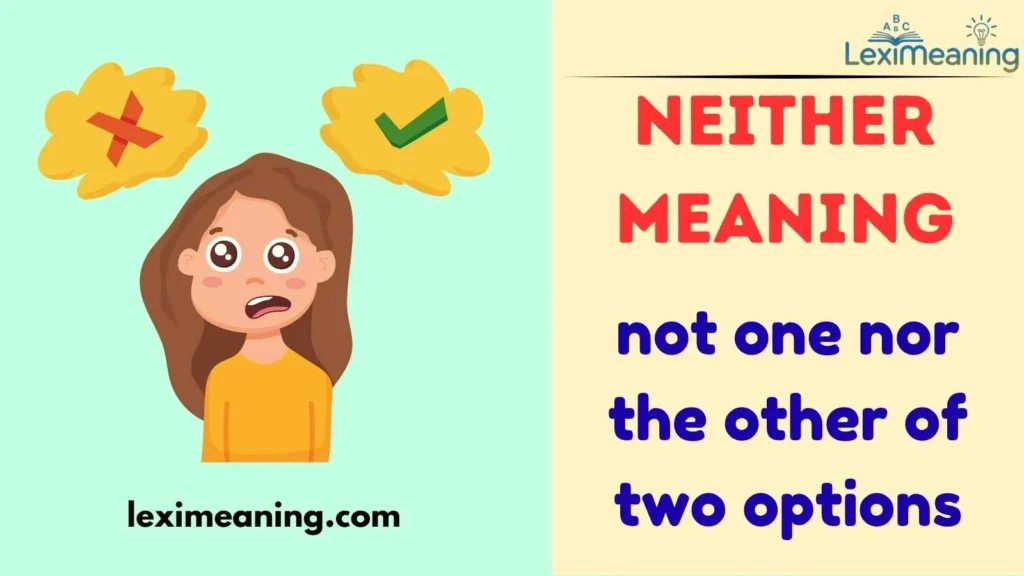
The neither meaning refers to “not one nor the other of two options.” It is used when talking about two specific things, and it excludes both.
In simple terms:
Neither means “not this one and not that one.”
It’s a word of double exclusion, always involving two choices.
How Neither Is Used in Everyday Language
In daily conversation, neither is often used to:
- Reject two options
- Agree with a negative statement
- Clarify that something applies to none of two things
For example, if two options are offered and you don’t want either, neither is the natural choice.
Neither in Negative Statements
One common use of neither is agreeing with a negative statement.
For example:
- “I don’t like coffee.”
“Neither do I.”
Here, neither means the same negative situation applies to the speaker as well.
Neither vs Either: Understanding the Difference
Neither and either are often confused, but they are opposites.
- Either refers to one of two options
- Neither refers to none of the two options
Understanding this contrast helps avoid logical errors in sentences.
Neither as a Determiner
Neither can be used before a noun to show exclusion.
For example:
- Neither option worked
- Neither answer was correct
In this form, it directly modifies the noun.
Neither as a Pronoun
Neither can also stand alone as a pronoun.
For example:
- “Which one do you want?”
“Neither.”
Here, the noun is implied, and the meaning is still clear.
Neither With “Nor”
Neither is often paired with nor to connect two negative alternatives.
For example:
- Neither the manager nor the staff were available
This structure emphasizes that both elements are excluded.
Neither and Verb Agreement
One area where people often struggle is verb agreement.
Even though neither refers to two things, it is grammatically singular.
For example:
- Neither option is acceptable
However, informal speech sometimes uses plural verbs, especially when the nouns feel plural.
Neither in Formal and Informal Writing
In formal writing, neither is preferred for precision and clarity.
In informal speech, people sometimes replace it with:
- “Not either one”
- “None of them”
Still, neither remains the most concise and grammatically correct option.
Real-Life Examples of Neither in Use
Examples make the neither meaning clearer.
Examples:
- “Neither answer makes sense.”
- “I didn’t call her.”
“Neither did I.” - “Neither plan fits the budget.”
Each example excludes both available choices.
Common Misunderstandings About Neither
Mistake1: Using Neither for More Than Two Things
Neither should only be used for two items, not three or more.
Mistake2: Mixing Up Neither and Either
Using the wrong one can reverse the meaning of a sentence.
Mistake3: Forgetting Subject-Verb Agreement
Neither usually takes a singular verb.
😊Neither in Questions
Neither can also appear in questions to clarify exclusions.
For example:
- “Did either option work?”
“Neither worked.”
This keeps the response clear and concise.
Neither in Comparisons
When comparing two things, neither helps eliminate both options.
For example:
- “Neither solution is ideal.”
This is often used when discussing limitations or compromises.
Neither and Tone
The tone of neither is usually neutral.
However, depending on context, it can sound:
- Firm
- Decisive
- Slightly formal
It’s commonly used when making clear, final statements.
Neither in Professional Communication
In professional settings, neither is useful for:
- Clarifying decisions
- Writing reports
- Explaining outcomes
Its precision helps avoid ambiguity.
Why Neither Still Matters
, clarity in language is essential across:
- Digital communication
- Workplace writing
- Education
Neither remains relevant because it expresses exclusion clearly without unnecessary words.
Neither Compared to Similar Words
Words sometimes confused with neither include:
- None
- Not either
Neither is unique because it applies only to two specific options.
How to Use Neither Correctly
To use neither properly:
- Limit it to two items
- Pair it with nor when needed
- Watch verb agreement
Correct example:
“Neither candidate meets the requirements.”
Incorrect example:
“Neither of the three options works.” (Use none instead)
Neither in Learning English
For learners, neither is an important word because:
- It appears frequently
- It has a clear logical function
- It improves sentence accuracy
Mastering it makes speech and writing more precise.
Why Understanding Neither Improves Communication
Understanding neither helps you:
- Avoid logical confusion
- Express disagreement clearly
- Respond naturally in conversation
It’s a small word with a big impact.
Conclusion:
The neither meaning refers to excluding both of two options. Whether used alone, with nor, or as part of a response, neither helps communicate clear and precise negative choices.
, knowing how to use neither correctly strengthens both spoken and written English. When clarity matters—and it often does—neither remains an essential part of effective communication.
💬 Your turn:
Do you ever mix up neither and either? Share an example or question!

I’m Daniel Brookes, the creator of LexiMeaning.com, where I make words, phrases, and their meanings simple and easy to understand. I’m passionate about clear language and helping readers discover the meaning, usage, and context behind everyday words. Through LexiMeaning.com, I aim to make learning new words simple, useful, and enjoyable.