
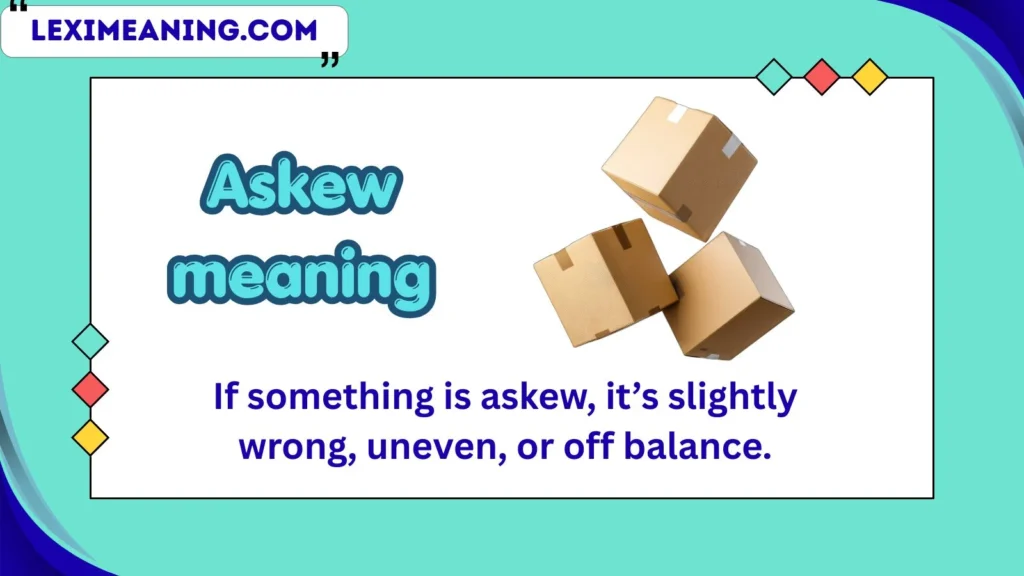
The word askew often appears in writing, news articles, literature, and everyday conversation but many people pause when they hear it.
Does it mean broken, crooked, wrong, or just slightly off? Understanding the askew meaning helps you visualize situations more clearly and use the word accurately when describing things that aren’t quite right.
clear and expressive language matters more than ever. Askew is a compact word that communicates imbalance, misalignment, or disorder without sounding harsh.
This article explains the meaning of askew in simple terms, shows how it’s used in real life, and explores why it remains relevant in modern English.
What Does Askew Mean?
The askew meaning refers to something that is out of alignment, crooked, tilted, or not in its proper position. It can describe physical objects, situations, plans, or even emotions.
In simple terms:
If something is askew, it’s slightly wrong, uneven, or off balance.
The word often implies:
- Not straight
- Not symmetrical
- Not as intended
It usually suggests minor disorder rather than complete failure.
Where the Word Askew Comes From
The word askew comes from Middle English and is believed to be influenced by Scandinavian language roots meaning turned sideways or out of line. From its origin, the word has always carried a visual sense of misalignment.
Because of this, askew works well in both literal and figurative descriptions.
How Askew Is Used in Everyday Language
In daily communication, askew is commonly used to describe things that look or feel slightly off.
Examples include:
- “The picture frame is hanging askew.”
- “His tie was slightly askew.”
- “After the news, her plans went askew.”
These examples show how the word applies to both physical objects and abstract situations.
Askew in Physical Descriptions
Askew is often used to describe objects that are:
- Crooked
- Tilted
- Uneven
For example:
“The shelf sat askew on the wall.”
This doesn’t mean the shelf is broken just improperly aligned.
Askew Used Figuratively
Beyond physical objects, askew is commonly used in a figurative sense.
For example:
“The schedule went askew after the delay.”
Here, askew describes disruption rather than physical alignment.
This figurative use makes the word especially flexible in modern language.
Real-Life Examples of Askew in Context
Casual Example
“One pillow was askew on the couch.”
Work Example
“The project timeline went askew due to supply issues.”
Emotional Example
“Her thoughts felt askew after the argument.”
Each example shows imbalance rather than total collapse.
Askew vs Similar Words
Understanding similar words helps clarify meaning.
- Crooked – bent or not straight, often physically
- Skewed – distorted or biased
- Tilted – leaning in one direction
- Off-kilter – slightly unstable
Askew usually suggests something is slightly out of place, not severely damaged.
Common Misunderstandings About Askew
Mistake #1: Thinking Askew Means Broken
Askew usually implies minor misalignment, not damage.
Mistake #2: Confusing Askew With Skewed
Skewed often refers to data or perspective, while askew is more visual or situational.
Mistake #3: Assuming It’s Only Physical
Askew can describe plans, thoughts, or situations as well.
Askew in Writing and Storytelling
Writers often use askew to:
- Create visual detail
- Show subtle disorder
- Suggest emotional imbalance
Example:
“His smile was askew, revealing his uncertainty.”
The word adds nuance without lengthy explanation.
Askew in News and Commentary
In journalism and commentary, askew is used to describe:
- Disrupted plans
- Unexpected outcomes
- Systems slightly out of balance
For example:
“The market expectations went askew after the announcement.”
This usage signals disruption without exaggeration.
Why Askew Is Still Relevant
many conversations focus on:
- Change
- Uncertainty
- Adjustment
Askew fits perfectly into this language landscape because it describes situations that are unsettled but not hopeless. It captures imperfection without drama.
How to Use Askew Correctly
To use askew naturally:
- Apply it to things that are slightly misaligned
- Use it when something isn’t functioning as intended
- Avoid using it for total chaos
Correct example:
“The arrangement looked a bit askew.”
Less accurate example:
“The entire system was destroyed and askew.” (Too extreme)
Is Askew Formal or Informal?
Askew is neutral and versatile.
It works well in:
- Casual conversation
- Professional writing
- Literature and media
Its flexibility is why it continues to be widely used.
Why Understanding Askew Matters
Knowing the askew meaning helps you:
- Visualize descriptions accurately
- Communicate subtle problems clearly
- Interpret tone in writing and speech
It’s a small word that adds precision and imagery.
Askew and Emotional Expression
People often use askew to describe internal states.
Example:
“Everything felt a little askew today.”
Here, the word communicates unease without overstatement, making it emotionally relatable.
Conclusion:
The askew meaning centers on being out of alignment whether physically, emotionally, or situationally. It describes things that aren’t quite right but not entirely broken, making it a powerful and subtle word.
As people navigate change and complexity, askew remains relevant because it captures those in-between moments of imbalance. Used thoughtfully, it adds clarity, tone, and imagery to communication.
🧩 Your turn:
What’s something you’d describe as askew today a plan, an object, or a mood? Share your thoughts.

I’m Daniel Brookes, the creator of LexiMeaning.com, where I make words, phrases, and their meanings simple and easy to understand. I’m passionate about clear language and helping readers discover the meaning, usage, and context behind everyday words. Through LexiMeaning.com, I aim to make learning new words simple, useful, and enjoyable.