
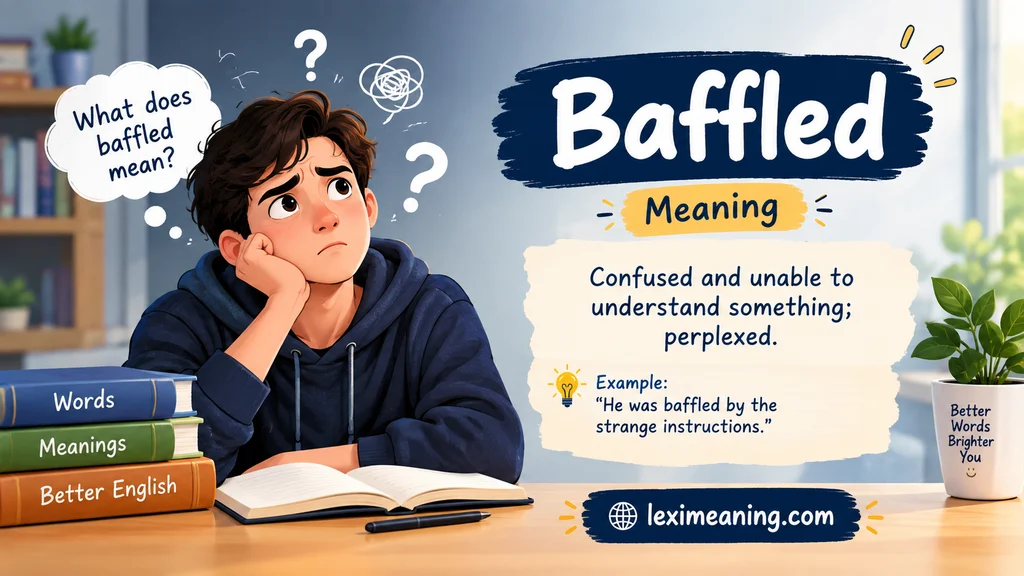
Have you ever read a message, heard a comment, or seen a situation unfold and thought, “I honestly have no idea what just happened”? That feeling is exactly what the word baffled describes.
Understanding the baffled meaning helps you express confusion clearly and recognize it when others use the word in conversation, writing, or online posts.
In 2026, with fast-moving information, confusing trends, and constant updates across digital platforms, feeling baffled is more common than ever.
This article breaks down what baffled really means, how it’s used in everyday language, real-life examples, and common mistakes so you can use the word naturally and correctly.
What Does Baffled Mean?
The baffled meaning refers to feeling completely confused, puzzled, or unable to understand something. When someone is baffled, they don’t just lack information—they genuinely can’t make sense of what’s happening.
In simple terms:
Being baffled means your brain hits a wall.
It often implies:
- Mental confusion
- Surprise mixed with uncertainty
- A temporary inability to process information
Baffled is stronger than mild confusion but not as intense as panic.
Where the Word Baffled Comes From
The word baffled originally meant to block or frustrate someone’s efforts. Over time, its meaning shifted from physical obstruction to mental confusion.
That evolution makes sense—when something blocks your understanding, you feel baffled.
Today, the word is almost entirely used to describe mental or emotional confusion, not physical obstacles.
How Baffled Is Used in Everyday Language
Baffled is commonly used in:
- News articles
- Workplace discussions
- Academic writing
- Casual conversations
- Social media captions
You’ll often see it paired with:
- “completely”
- “totally”
- “absolutely”
Examples:
- “I’m completely baffled by this.”
- “She looked baffled by the response.”
The word clearly communicates confusion without sounding childish or informal.
Real-Life Examples of Baffled in Context
Everyday Conversation
“I reread the instructions three times and I’m still baffled.”
Workplace Example
“The team was baffled by the sudden change in strategy.”
News Example
“Experts remain baffled by the unexpected results.”
Online or Social Media Use
“This update has me baffled 😭”
In all these examples, baffled expresses confusion that feels genuine and unresolved.
Baffled vs Similar Words
Understanding related words helps clarify the baffled meaning.
- Confused – lacking clarity, mild uncertainty
- Puzzled – curious confusion, often thoughtful
- Perplexed – thoughtful, slightly formal confusion
- Bewildered – strong confusion, often emotional
Baffled usually suggests mental blockage, not just curiosity.
Is Baffled a Strong Word?
Yes—but it’s not dramatic.
Baffled sits in the middle:
- Stronger than “confused”
- Weaker than “shocked” or “overwhelmed”
It’s ideal when:
- Something doesn’t make logical sense
- You’re surprised by an outcome
- You can’t figure out why something happened
This balance makes it useful in both formal and casual language.
How Baffled Is Used in Professional Settings
In professional or academic environments, baffled is often used to express:
- Unexplained results
- Unexpected outcomes
- Logical inconsistencies
For example:
“Researchers were baffled by the data patterns.”
This shows confusion without implying incompetence.
Baffled in Media and Journalism
Journalists frequently use baffled to describe:
- Unsolved cases
- Confusing political decisions
- Unexpected scientific findings
It helps communicate uncertainty while maintaining a neutral tone.
Example:
“Authorities are baffled by the sudden disappearance.”
Common Mistakes When Using Baffled
Mistake #1: Using It for Mild Confusion
If you understand something but dislike it, baffled may be too strong.
Incorrect:
“I’m baffled by this movie—it was boring.”
Better:
“I was confused by the plot.”
Mistake #2: Using It for Emotional Shock
Baffled is about understanding, not emotional trauma.
Incorrect:
“I was baffled by the bad news.”
Better:
“I was shocked by the bad news.”
Mistake #3: Overusing It Online
Using baffled too often can weaken its impact. Save it for moments of real confusion.
How to Use Baffled Correctly in a Sentence
To use baffled well:
- Pair it with unclear situations or information
- Use it when confusion feels genuine
- Avoid using it for simple misunderstandings
Correct examples:
- “I’m baffled by how this works.”
- “They were baffled by the conflicting instructions.”
Incorrect example:
- “I’m baffled because I forgot.” (Not confusion—just memory)
Baffled in Emotional and Mental Contexts
Being baffled doesn’t mean being unintelligent. In fact, it often suggests:
- Critical thinking
- Awareness of complexity
- Recognition that something doesn’t add up
People who say they’re baffled are usually engaging honestly with confusion rather than ignoring it.
Why Feeling Baffled Is So Common in 2026
In 2026, people face:
- Rapid technology changes
- Information overload
- Constant updates and trends
Feeling baffled has become a normal response to:
- Confusing systems
- Sudden changes
- Contradictory information
The word remains relevant because it captures a very modern mental state.
Baffled vs Ignorant: An Important Difference
Being baffled means:
- You’re trying to understand
- Something doesn’t make sense yet
Being ignorant means:
- Lacking knowledge
- Not necessarily trying to learn
Using baffled shows effort and engagement, not lack of intelligence.
Can Baffled Be Used Humorously?
Yes—especially online.
People often use baffled humorously to exaggerate confusion:
“I watched one tutorial and now I’m baffled for life.”
This playful usage still fits the core meaning.
Conclusion:
The baffled meaning centers on genuine confusion when something doesn’t make sense despite effort or attention. It’s a powerful word that communicates mental blockage without sounding dramatic or negative.
In 2026, as information becomes more complex and fast-paced, baffled remains one of the most accurate words for expressing modern confusion. Knowing how to use it correctly helps you communicate more clearly, whether you’re writing, speaking, or posting online.
💬 Your turn:
What’s the last thing that left you completely baffled? Share your moment and let’s laugh (or learn) together.

I’m Daniel Brookes, the creator of LexiMeaning.com, where I make words, phrases, and their meanings simple and easy to understand. I’m passionate about clear language and helping readers discover the meaning, usage, and context behind everyday words. Through LexiMeaning.com, I aim to make learning new words simple, useful, and enjoyable.